A demo, not a description.
The product shows its own safety net: a plan, a budget check and an approval step.
An AI tool for live ad accounts.
A brand with a pulse.
A free trial one click away.
A marketer about to give an AI assistant access to live ad budgets has two fears: a change nobody approved, and a usage meter that turns every question into a bill. A SaaS website for that buyer has to answer both before it asks for a sign-up.
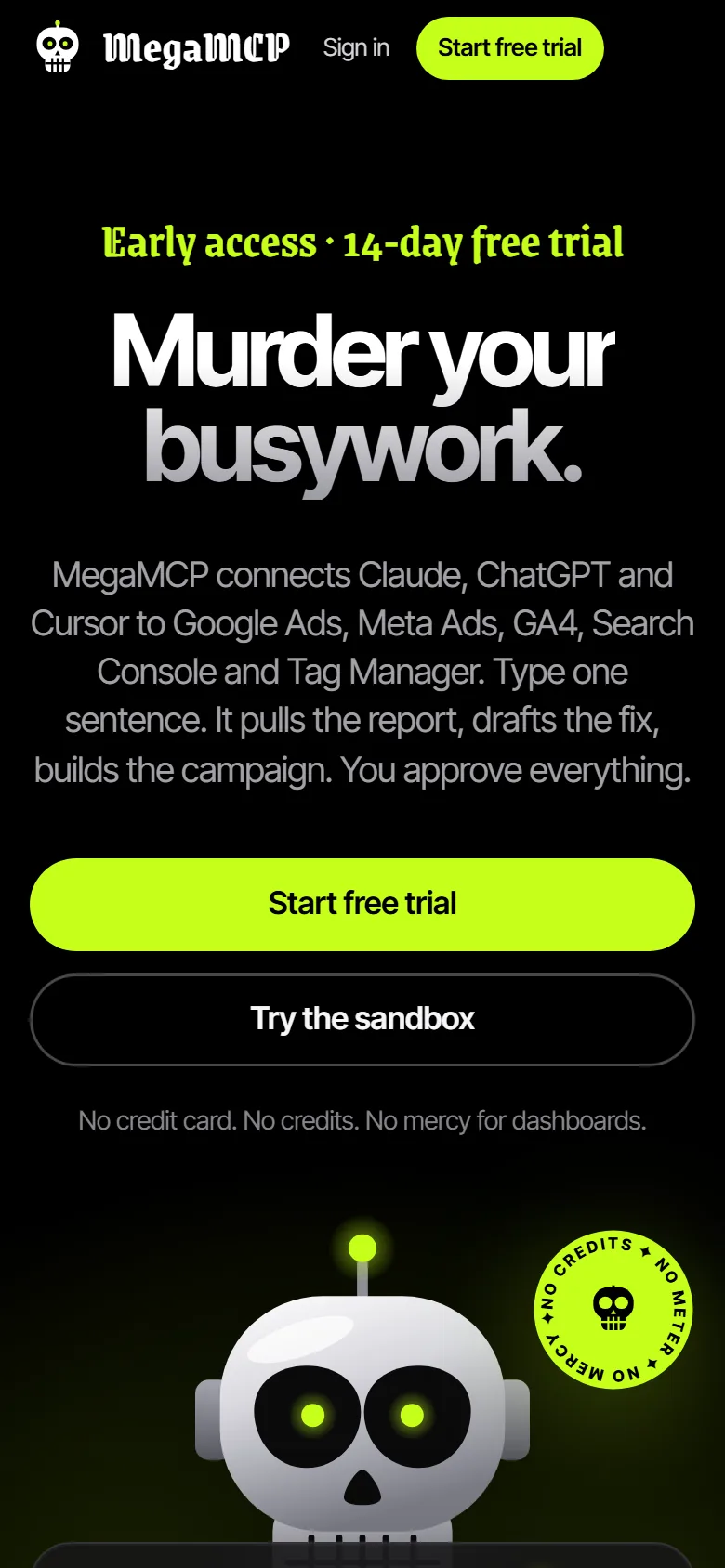
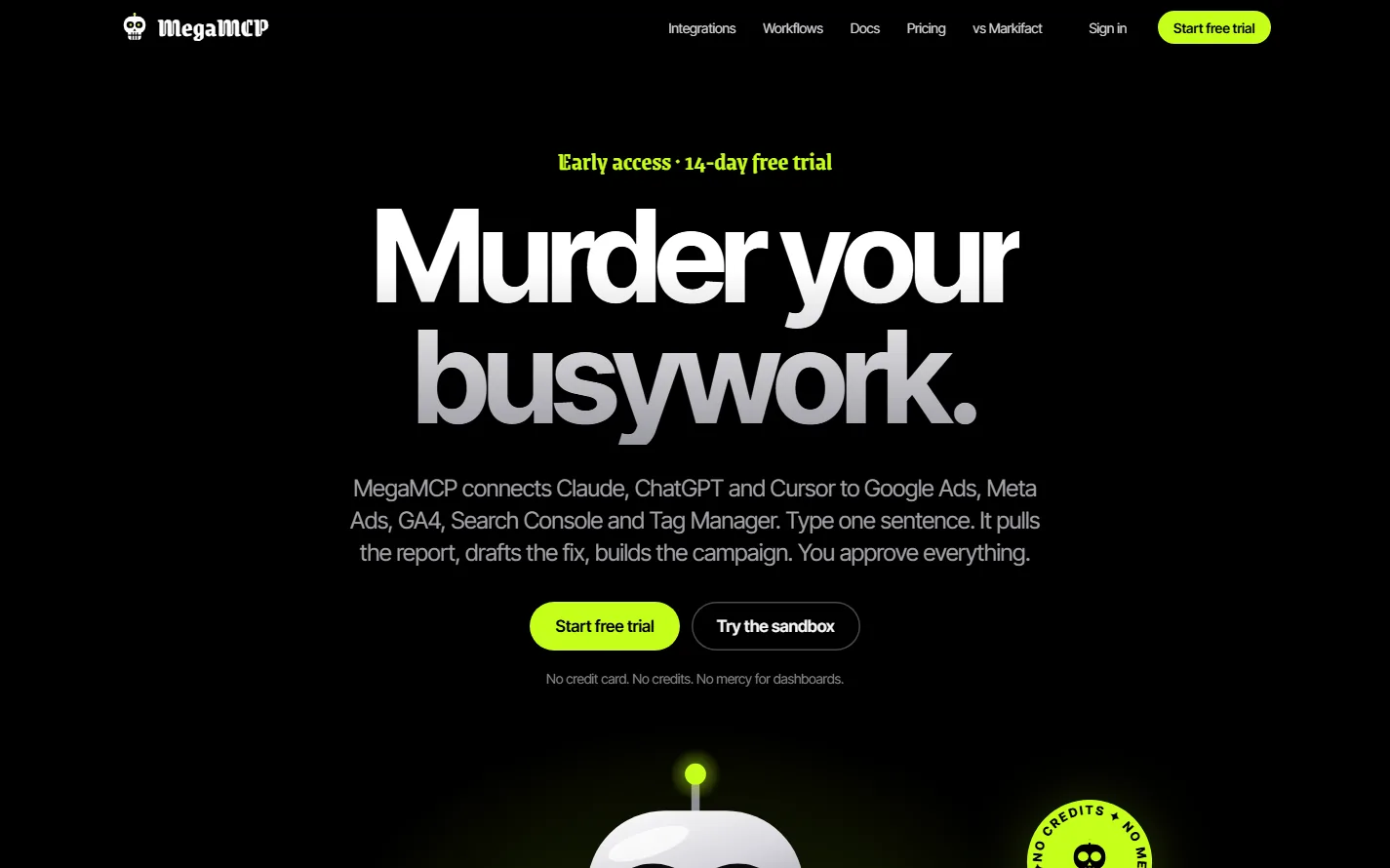
The MegaMCP homepage answers them in the opening screen. A Claude conversation drafts a Google Ads campaign, labels it “Nothing is live yet,” checks it against a daily budget cap and waits behind Approve and Reject buttons. Directly above it, the offer promises no credits and no credit card to start.
This study looks at the visible website: its positioning, brand voice, pricing story and the page structure that helps it get found.
MCP servers are new, abstract and easy to explain badly.
The website skips the protocol lecture and talks about the job: “Type one sentence. It pulls the report, drafts the fix, builds the campaign. You approve everything.” A skull-faced robot, an acid-green accent and lines like “Credits are for arcades” give the brand a personality that a crowded AI-tools market rarely has.
The humor never replaces the proof. Every joke sits on top of a concrete claim a buyer can check: line-by-line diff previews, one-click undo, budget caps on every ad account and a 90-day history of every change.
The hero demo previews a change and waits for approval, so the biggest objection is handled before the first scroll.
Flat plans from £39 a month and a dated, sourced comparison table make “no credits” a claim a buyer can verify.
Integrations are labeled Live, Rolling out or Coming soon, with a plain explanation of Google and Meta app review.
People rarely search for a brand they have not heard of. They search for the job: a Google Ads MCP server, an AI assistant for GA4, a way to find wasted ad spend. The site structure gives each of those searches its own destination.
Twelve integration pages cover platforms from Google Ads and Meta Ads to Shopify, HubSpot and Klaviyo. Fourteen workflow pages describe specific scheduled jobs, such as a search-term sweeper and a spend-anomaly alert. Setup guides cover Claude, ChatGPT, Cursor, Claude Code and VS Code, and a comparison page meets buyers who are already evaluating a competitor.
Underneath, the homepage carries SoftwareApplication, Offer, Organization and FAQPage structured data, and every page lives in an XML sitemap with breadcrumbs back to its hub. It is the same thinking we bring to SEO audits and AI search visibility work.
Visit MegaMCP to watch the demo, browse the integrations and compare the plans.
A SaaS website has to explain the product, earn trust with a skeptical buyer and turn curiosity into a trial, often before the product is fully known. The work begins with the buyer’s biggest objection, the proof that answers it and the searches that bring the right people in.
Planning a launch or a SaaS website redesign? See how a website project is scoped, or look at another software product in the Toolcaise case study.
Next project: ToolcaiseBring the product, the buyer and the objection your website needs to answer.